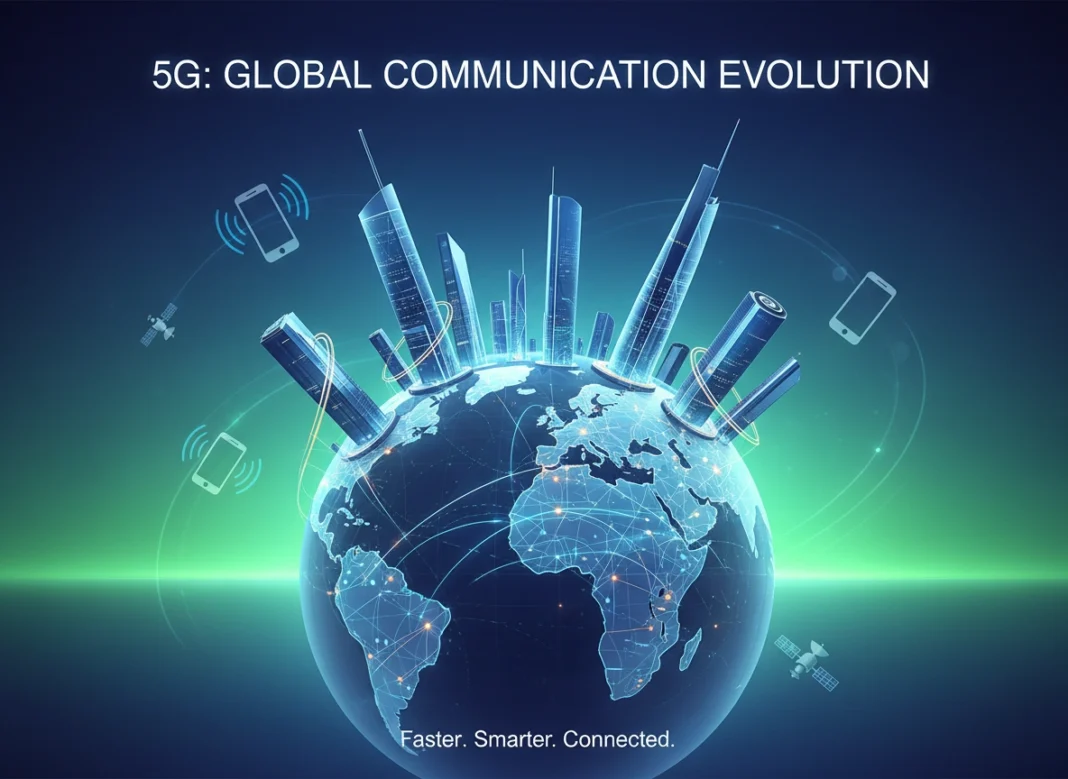
The evolution of wireless technology has consistently reshaped how we interact with the world. From the first mobile phone calls on 1G to the mobile internet access of 4G, each generation brought significant changes. Now, the fifth generation, or 5G, is here, and it represents not just an incremental improvement but a fundamental leap forward. This technology is redefining the limits of speed, reliability, and connectivity, unlocking new possibilities across countless industries and aspects of daily life.
5G is more than just faster downloads; it is a powerful platform for innovation. By offering unprecedented performance, it is transforming communication from a simple exchange of information into a seamless, instantaneous, and immersive experience. This article explores the core features of 5G, its impact on various sectors, and what the future holds as this technology becomes more widespread.
What is 5G and How is it Different?
5G is the latest global wireless standard, engineered to connect virtually everyone and everything together, including machines, objects, and devices. To understand its transformative power, it’s essential to see how it builds upon and surpasses its predecessors.
While 4G LTE (Long-Term Evolution) enabled high-quality video streaming and a robust mobile app ecosystem, it has limitations, especially as the number of connected devices explodes. 5G addresses these shortcomings with three key features:
- Enhanced Mobile Broadband (eMBB): This is the feature most people associate with 5G—incredibly fast speeds. Theoretically, 5G can reach peak data rates of up to 10 gigabits per second (Gbps), making it up to 100 times faster than 4G. This means downloading a full-length HD movie could take mere seconds instead of several minutes.
- Ultra-Reliable Low-Latency Communication (URLLC): Latency is the delay between sending and receiving information. 4G has a latency of around 50 milliseconds, whereas 5G can reduce this to as low as 1 millisecond. This near-instantaneous response time is critical for applications that require real-time control, such as autonomous vehicles and remote surgery.
- Massive Machine-Type Communication (mMTC): 5G is designed to support a massive number of connected devices simultaneously. It can handle up to one million connected devices per square kilometer, a significant increase from 4G. This capability is the backbone of the Internet of Things (IoT), enabling smart cities, smart homes, and industrial automation on a vast scale.
These advancements are made possible by new technologies, including the use of higher-frequency millimeter-wave (mmWave) bands, advanced antenna technologies (like massive MIMO), and network slicing, which allows for the creation of multiple virtual networks on top of a common physical infrastructure.
The Real-World Impact on Communication
The theoretical benefits of 5G are impressive, but its true value lies in its practical applications. The combination of high speed, low latency, and massive connectivity is already beginning to revolutionize communication across various sectors.
Healthcare: A New Era of Telemedicine
The healthcare industry is one of the most promising arenas for 5G innovation. Low-latency communication is making advanced telemedicine a reality. Doctors can now perform remote diagnostics with high-resolution imaging and real-time data streaming. For example, a specialist in a major city could guide a paramedic in a rural ambulance through a complex procedure using augmented reality (AR) overlays.
Furthermore, URLLC is a crucial enabler for telesurgery. Surgical robots controlled by a surgeon miles away require a connection that is both stable and instantaneous, as any delay could have life-threatening consequences. 5G provides the reliability needed for such critical applications. Wearable IoT devices that monitor patients’ vitals in real-time can transmit continuous data to healthcare providers, allowing for proactive care and early intervention.
Education and Work: Breaking Down Physical Barriers
The shift to remote work and learning has highlighted the need for better digital infrastructure. While 4G can support video conferencing, it often struggles with large groups or high-bandwidth applications. 5G’s enhanced broadband capabilities allow for seamless, high-definition video collaboration without lag or buffering.
More importantly, 5G opens the door to immersive learning experiences through AR and virtual reality (VR). Medical students could perform virtual dissections, and history students could take virtual tours of ancient civilizations. For remote workers, 5G can power “virtual offices” where colleagues collaborate in a shared digital space, fostering a greater sense of presence and teamwork than a simple video call.
Entertainment and Media: Immersive Experiences on the Go
The entertainment industry has always been quick to adopt new technologies. With 5G, the way we consume media is set for another major shift. The high bandwidth allows for streaming 8K video and cloud-based gaming on mobile devices without the need for powerful local hardware. Gamers can play console-quality titles on their smartphones, with the processing handled in the cloud and the gameplay streamed instantly to their screen.
Live events are also being transformed. Imagine attending a concert and being able to switch between multiple camera angles in real-time on your phone, or using AR to see player stats overlaid on the field during a live sports game. 5G’s massive capacity ensures that even in a crowded stadium, thousands of users can enjoy these experiences simultaneously without network congestion.
Smart Cities: The Connected Urban Environment
The concept of a “smart city” relies on a vast network of interconnected sensors and devices that collect and share data to improve urban life. This is where 5G’s massive machine-type communication comes into play. 5G networks can support the millions of sensors needed to manage traffic flow, monitor air quality, optimize energy consumption, and improve public safety.
For instance, intelligent traffic management systems can analyze real-time data from connected vehicles and road sensors to adjust traffic signals and reroute drivers, reducing congestion and emissions. Connected public transportation can provide more accurate arrival times and improve service efficiency. Autonomous vehicles, which need to communicate with each other and with city infrastructure in real-time, depend entirely on the low latency and reliability that 5G offers.
Looking Ahead: The Future of 5G and Beyond
The deployment of 5G is still in its early stages, with coverage and capabilities continuing to expand. As the technology matures and becomes more ubiquitous, we can expect even more groundbreaking applications to emerge. The full potential of 5G will be realized when it is integrated with other advanced technologies like artificial intelligence (AI) and edge computing.
AI algorithms can analyze the vast amounts of data generated by 5G-connected devices to make intelligent decisions in real-time. Edge computing, which processes data closer to where it is generated instead of in a centralized cloud, will further reduce latency and improve the efficiency of 5G applications.
In the coming decade, 5G will become the invisible fabric that connects our digital and physical worlds. It will enable a future where autonomous systems are commonplace, virtual and augmented realities are integrated into our daily lives, and communication is truly instantaneous and seamless. The transformation is just beginning, but one thing is clear: 5G is not just another ‘G’—it is the foundation for the next era of human and machine communication.
Please click here for more info