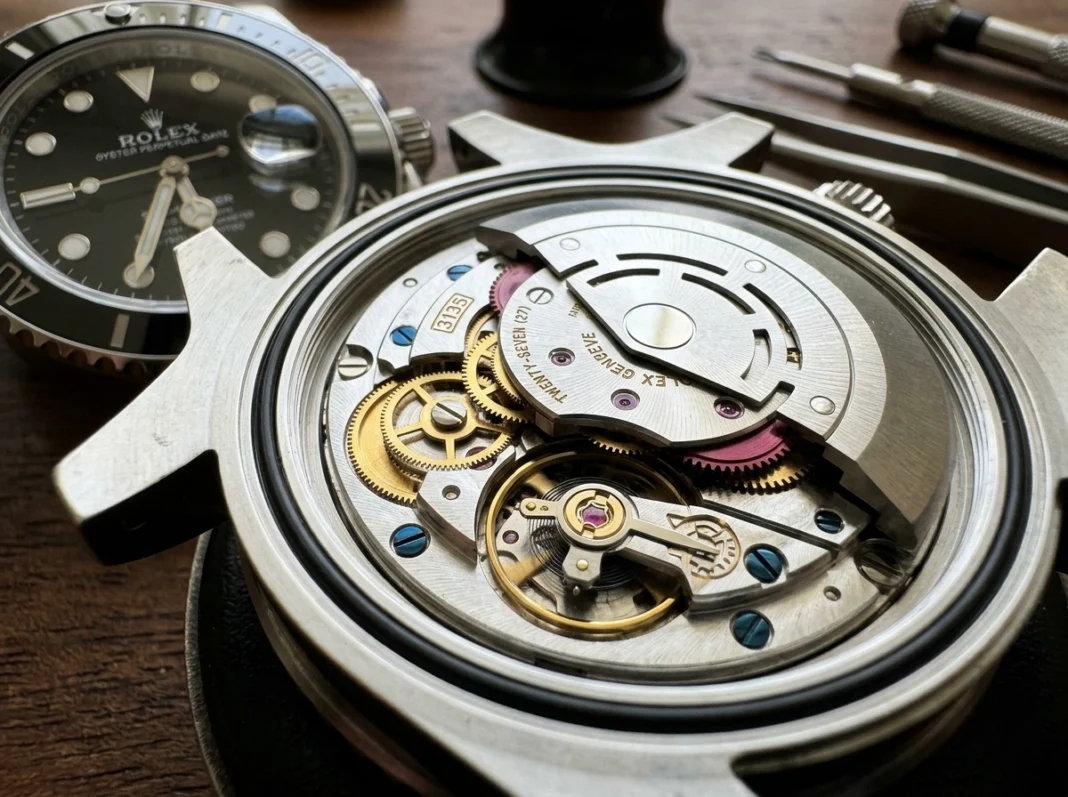
The movement is the beating heart of any timepiece. It powers every tick, sweep, and complication you see on the dial. When people talk about replica Rolex watches, they often focus on looks—the case shine, the dial layout, the weight in hand. Yet the real story lives inside. The movement determines how a watch performs, how long it lasts, and how closely it mirrors the experience of an authentic piece.
This article breaks down the mechanics that matter. You will learn the difference between automatic and quartz movements, the core components that drive them, and the craftsmanship factors that separate a forgettable copy from a convincing one. We will also cover quality differences, maintenance basics, and the practical things buyers evaluate before deciding. The goal is simple: help you understand what is actually happening under that case back.
What a Watch Movement Really Does
A movement, sometimes called a “caliber,” is the internal mechanism that keeps time and drives the hands. Think of it as the engine. Everything else—the case, crystal, and bracelet—is the body built around that engine.
Movements fall into two broad categories: mechanical (which includes automatic) and quartz. Each works in a fundamentally different way. Understanding both helps you judge what you are looking at and what trade-offs come with each choice.
Automatic vs Quartz: The Core Difference
The biggest decision point in any watch movement is how it stays powered. Here is how the two main types compare.
Automatic (Self-Winding) Movements
An automatic movement is purely mechanical. It uses a tightly wound mainspring to store energy. As the spring slowly releases, it powers a series of gears that move the hands.
The clever part is the rotor—a weighted half-disc that spins as your wrist moves. That motion winds the mainspring automatically, which is where the “self-winding” name comes from. Authentic Rolex calibers are famous for this smooth, hands-free winding.
Automatic movements appeal to enthusiasts because they feel alive. The seconds hand glides in a near-continuous sweep rather than ticking once per second. Many buyers seeking realistic replica Rolex watches prefer automatics specifically because that sweeping motion is one of the hardest details to fake convincingly.
Quartz Movements
A quartz movement runs on a small battery. An electric current passes through a quartz crystal, which vibrates at a precise frequency. That frequency is converted into steady, regulated pulses that move the hands.
Quartz is highly accurate and requires little upkeep beyond a battery change every couple of years. The trade-off is the motion: quartz watches usually tick in distinct one-second jumps. To a trained eye, that ticking can give away a watch trying to imitate a mechanical original.
Quick comparison:
- Power source: Automatic uses wrist motion; quartz uses a battery.
- Accuracy: Quartz is generally more precise day to day.
- Maintenance: Automatics need periodic servicing; quartz mainly needs batteries.
- Feel: Automatics sweep smoothly; quartz ticks.
Common Components Inside the Movement
Whether mechanical or quartz, several parts work together to keep accurate time. Knowing these names helps you read product descriptions and spot vague or inaccurate listings.
- Mainspring: Stores energy in mechanical movements.
- Rotor: The weighted piece that winds an automatic movement through motion.
- Escapement: Releases energy in controlled steps so the watch keeps even time.
- Balance wheel: Oscillates back and forth, acting like the movement’s metronome.
- Gear train: A chain of gears that transfers energy to the hands.
- Jewels: Tiny synthetic rubies placed at friction points to reduce wear.
In higher-grade replicas, makers try to mimic these components closely. Lower-grade versions may use simplified parts that look similar on the surface but behave differently over time.
Craftsmanship Considerations
Not all movements are built to the same standard, and craftsmanship is where the gap shows. A well-finished movement has clean parts, consistent lubrication, and properly aligned gears. A rushed one often runs loud, loses time quickly, or wears out faster.
Several craftsmanship factors stand out:
- Finishing: Quality movements show neat edges and uniform plating. Cheap ones look rough under magnification.
- Assembly tolerance: Tight, precise fitting reduces friction and improves reliability.
- Component sourcing: Better movements use sturdier metals and properly cut gears.
- Regulation: A movement must be adjusted so it keeps accurate time across positions.
These details rarely appear in marketing photos, which is exactly why they separate convincing pieces from obvious copies.
Quality Differences Buyers Should Expect
Movement quality exists on a spectrum. On the lower end, you find basic calibers that tell time but struggle with accuracy and longevity. On the higher end, you find clones engineered to closely match the architecture of genuine calibers, sometimes with similar power reserves and smooth winding.
A few real-world signals of quality:
- Timekeeping accuracy: A good movement loses or gains only a few seconds per day.
- Power reserve: Better automatics keep running longer when off the wrist.
- Smoothness: The crown should wind easily, and the rotor should spin freely.
- Consistency: The watch should perform the same way week after week.
Imagine two watches that look identical on the shelf. One keeps near-perfect time for months; the other drifts noticeably within days. The difference is almost always the movement inside.
Maintenance Factors
Mechanical movements are precision machines, and like any machine, they need care. Lubricants dry out, parts settle, and accuracy can drift over the years. Periodic servicing—cleaning, oiling, and re-regulating—keeps an automatic running smoothly.
Quartz movements are lower maintenance but not maintenance-free. A dead battery left inside too long can leak and damage internal parts, so timely replacement matters.
Simple maintenance habits:
- Keep the watch away from strong magnets, which can disrupt accuracy.
- Avoid sudden impacts that can knock delicate parts out of alignment.
- Have automatics serviced periodically by someone who handles movements.
- Replace quartz batteries promptly rather than letting them sit dead.
What Buyers Typically Evaluate
When comparing movement performance, experienced buyers look past the dial and ask focused questions. Use this checklist as a starting point.
- Movement type: Is it automatic or quartz, and does that match what you want?
- Accuracy claims: How many seconds per day does it gain or lose?
- Winding feel: Does the crown turn smoothly without grinding?
- Seconds-hand motion: Does it sweep or tick, and does that fit the original?
- Power reserve: How long does it run unworn?
- Serviceability: Can parts be cleaned, oiled, or replaced when needed?
A common mistake is judging a watch only by its exterior. The fix is simple: weigh the movement details just as heavily as the case and dial.
Conclusion
The movement is what truly defines a watch’s character. Automatic calibers reward you with a living, sweeping motion and require occasional servicing, while quartz offers accuracy and low upkeep with a recognizable tick. Between those choices sit the details that matter most—components, craftsmanship, accuracy, and maintenance—which together determine whether a watch performs reliably for years or fades quickly.
If you are comparing options, start with the movement. Run through the buyer’s checklist above, test the winding feel, and watch how the seconds hand moves. Understanding these mechanics puts you in a far stronger position to judge quality and choose with confidence.