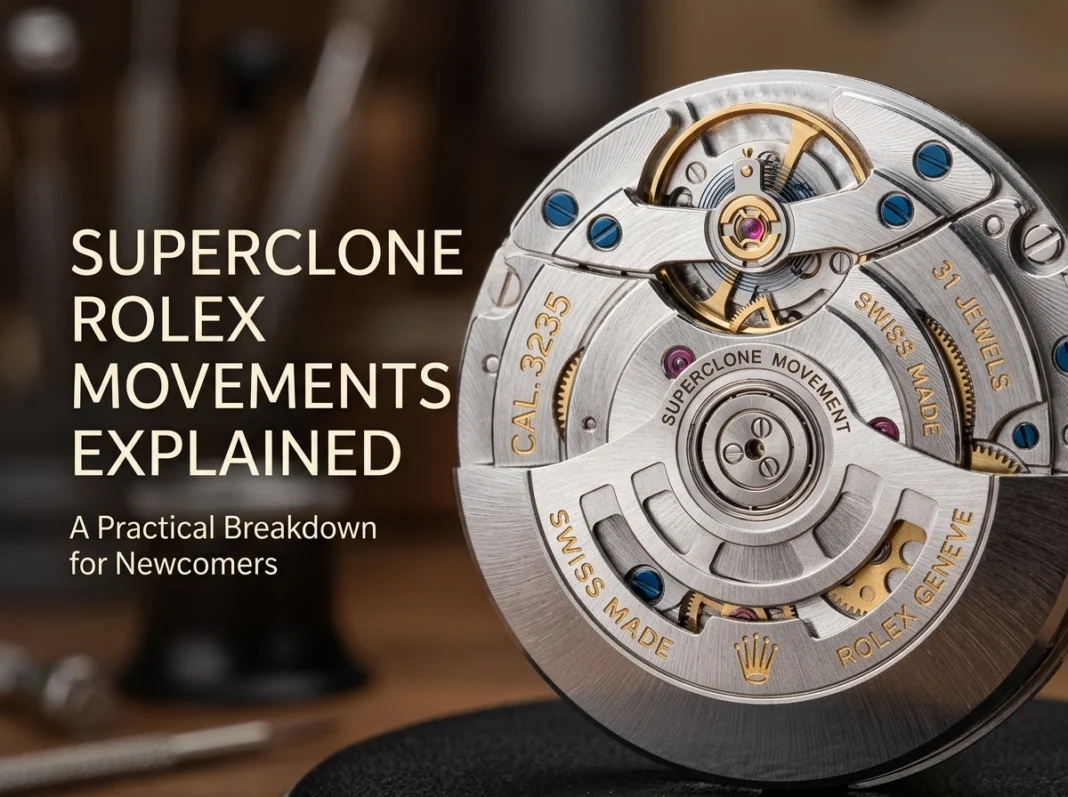
If you’ve started researching high-end replica watches, you’ve probably run into the term “superclone Rolex movement” more than once. It gets thrown around in forums, product listings, and review videos, often without a clear explanation. This article breaks the topic down in plain language so you can understand what these movements actually are, how they compare to other options, and what to look for before spending money.
By the end, you’ll know how to evaluate build quality, finishing, and reliability, what servicing involves, and which common myths to ignore. The goal here is education, not sales talk. Let’s get into it.
What “Superclone” Actually Means
A superclone movement is a replica caliber built to closely copy the architecture, layout, and visible details of a genuine Rolex movement. The word “clone” is the key part: rather than swapping in a generic automatic engine, the manufacturer tries to mirror the original movement’s design.
In practice, that means matching things like the bridge shapes, the position of the balance wheel, the rotor design, and even certain engravings. The “super” prefix simply signals a higher level of accuracy than older or cheaper clone attempts.
It’s worth being honest about the limits here. A superclone aims to look and behave like the real thing, but it is not made by Rolex and does not use Rolex’s exact materials or manufacturing standards. Treat the term as a description of intent and accuracy, not a guarantee of identical performance.
How Superclones Differ From Standard Replicas
Not all replica watches are built the same way. Understanding the categories helps you avoid overpaying for something basic.
Generic automatic movements
Many entry-level replicas use off-the-shelf calibers, often Chinese-made workhorses like the Miyota or a basic clone of a common Swiss base. These run fine, but they don’t match the visible layout of a Rolex movement. If someone opens the caseback, the difference is obvious.
Standard clone movements
A step up, these movements try to copy some elements of the genuine caliber but cut corners on finishing or internal components. They might look close from a distance but reveal rough edges under inspection.
Superclone movements
These are the most detailed tier. They aim to replicate both the appearance and the functional layout of the target caliber, including details like the balance bridge, jewel placement, and rotor engraving. The finishing is usually cleaner, and the movement is built to feel closer to the original in hand.
The practical takeaway: the further up this ladder you go, the more attention is paid to accuracy, finishing, and reliability, and the more you’ll typically pay.
What Newcomers Should Look For
When you’re new to this space, it’s easy to focus only on how a watch looks in photos. The movement deserves just as much attention. Here are the areas that matter most.
Build quality
Look for consistency. A well-built movement should run smoothly when you wind it, with no grinding or stiffness. The rotor should spin freely and quietly. Cheap movements often feel gritty or make uneven sounds, which can hint at poor assembly or low-grade parts.
Finishing
Finishing refers to the decorative and functional detailing on the movement, such as the polishing of edges, the texture on bridges, and the quality of engravings. On a stronger superclone, these details are crisper and more even. Sloppy finishing, smudged engravings, or visible tool marks usually point to a lower-tier product.
Accuracy and stability
A reliable automatic movement should keep reasonable time and hold a stable rate once it settles. No replica will match the certified standards of a genuine luxury caliber, so be realistic. If a movement keeps time within a sensible daily range and doesn’t stop unexpectedly, that’s a good practical sign for this category.
Power reserve and winding
Check how the watch behaves after a full day on the wrist versus sitting still overnight. A healthy movement should hold its charge as expected and restart smoothly with light wrist motion.
If you want to compare specific calibers and see how different builds are described, resources that focus on the superclone rolex niche can give you a sense of what’s currently available and how sellers categorize their products.
Reliability and Servicing Considerations
This is the part many newcomers overlook, and it’s arguably the most important.
Plan for maintenance
Like any mechanical movement, a superclone will eventually need servicing. Oils dry out, parts wear, and accuracy can drift over time. A reasonable expectation is periodic maintenance, similar in concept to a genuine automatic, though the parts and access to skilled watchmakers differ.
Finding a watchmaker
Not every local watchmaker will work on replica movements, and some will refuse outright. Before buying, it helps to know whether you can get the watch serviced if something goes wrong. Some owners learn basic maintenance themselves, while others build relationships with independent watchmakers who are comfortable with clone calibers.
Parts availability
Because superclones copy genuine layouts, some parts may be interchangeable with donor components, while others are specific to the clone. Availability varies, so don’t assume every part is easy to source. This is a practical reason to choose well-regarded movements over obscure ones.
Common Misconceptions
A few myths tend to confuse newcomers. Let’s clear them up.
“Superclone means identical to a real Rolex.” It doesn’t. The term describes a high level of accuracy, not a perfect match. Materials, tolerances, and long-term durability still differ from the genuine article.
“A higher price always means a better movement.” Price can reflect quality, but it can also reflect markup. Judge the movement on its actual build, finishing, and reputation rather than the price tag alone.
“Replicas never need servicing.” All mechanical watches need care eventually. Ignoring maintenance shortens a movement’s life.
“All clone movements are the same inside.” As shown earlier, there’s a real range from generic to superclone. The internal differences are significant, even if two watches look similar from the outside.
Putting It All Together
Here’s a simple checklist you can use when evaluating a superclone movement:
- Confirm the tier. Is it a generic, standard clone, or true superclone caliber?
- Inspect the finishing. Look for clean engravings and even detailing.
- Test the feel. Smooth winding, a free-spinning rotor, and quiet operation are good signs.
- Check timekeeping. Aim for a stable, sensible daily rate.
- Plan for service. Know your maintenance options before you buy.
Working through these steps gives you a grounded way to judge quality without relying on marketing claims.
Conclusion
Superclone Rolex movements sit at the top of the replica spectrum because they copy the layout, finishing, and feel of genuine calibers more closely than other options. Still, they remain replicas, not originals, and understanding that distinction keeps your expectations realistic.
For newcomers, the smart approach is straightforward: focus on build quality, finishing, and reliability, plan ahead for servicing, and ignore the common myths that cloud the topic. If you take the time to inspect a movement carefully and ask the right questions before buying, you’ll make a far more informed decision. Start with the checklist above, and let the details, not the hype, guide your choice.